Key takeaways
- An AI agent has three costs: build (once), run (every month) and improve (every month) — plus the team's time at the start, which is rarely written down.
- Bonsay's price for a first AI agent that automates one process starts at €5,000, fixed after an audit.
- The price of a given level of AI performance has fallen about 13 times a year (State of AI Report 2026, citing Epoch AI), but the model is usually the cheapest part of a business agent.
- McKinsey's study of 20 AI-leading companies found breakeven in one to two years and $3 of extra EBITDA for every $1 invested; they funded AI in stages.
How much does an AI agent cost? For a small or mid-sized business, a first AI agent that automates one process has three costs: building it once, running it every month, and improving it every month. At Bonsay the build starts from €5,000 at a fixed price, agreed after a 1–2 week audit and followed by a 2–4 week pilot; the monthly costs depend mostly on how many emails, quotes or calls the agent handles.
A price tag answers "how much to build it?". It does not answer the questions a finance director cares about: how much the agent costs to run every month, how much of the team's time it needs, and when it pays for itself. This guide covers those questions from the seller's side of the table: how Bonsay prices AI agents, where the money goes, what moves the price, and a worksheet for a budget you can defend.
The three costs of an AI agent
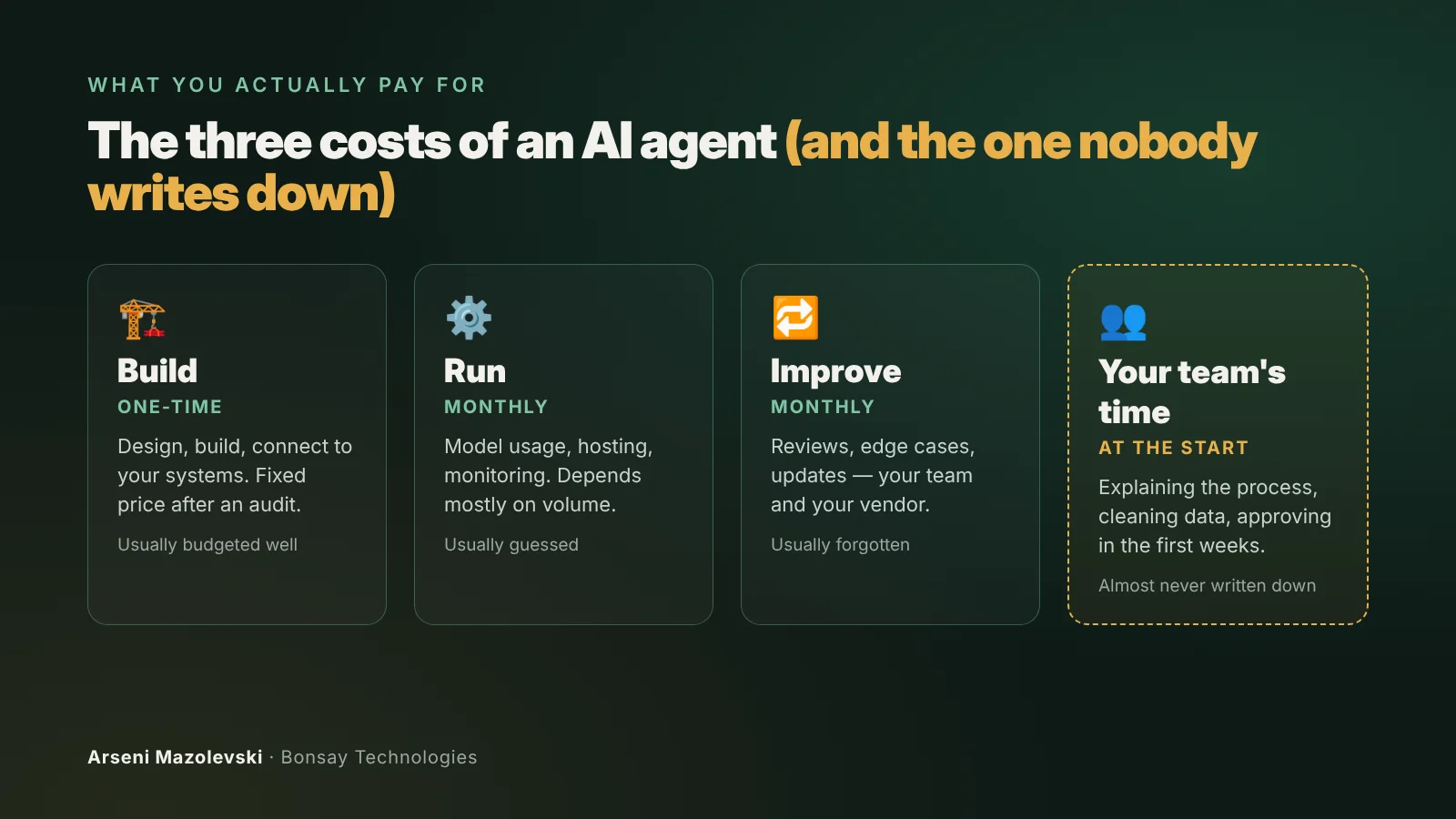
- Build (one-time): designing and building the agent and connecting it to your systems. At Bonsay this starts from €5,000 at a fixed price, after a 1–2 week audit and with a 2–4 week pilot.
- Run (monthly): what the AI provider charges for the model, plus hosting and monitoring. This depends mostly on volume: how many emails, quotes or calls the agent handles.
- Improve (monthly): the time your team and your vendor spend reviewing results, fixing edge cases and keeping the agent up to date.
Most AI budgets cover the first line well, guess the second and forget the third.
The cost nobody writes down: your team's time
An AI agent is closer to a new hire than to a software licence. When a company hires someone, the salary is only part of the cost: there is onboarding, the manager's time in the first months, and mistakes someone has to catch. Nobody is surprised by this, because everyone has hired a person before. Very few companies have "hired" an AI agent before, so the same costs come as a surprise:
- The team's time at the start. Someone has to explain how the process really works, find the right price lists and templates, and decide what the agent may do alone. In many AI projects this takes longer than writing the code.
- Data clean-up. If the product list lives in three spreadsheets that disagree with each other, the agent will disagree with itself too. Fixing that is real work.
- Review in the first weeks. A person approves anything risky until the agent has earned trust. That time is part of the budget.
None of this is a reason to wait. It is a reason to plan for it, so the project does not look "over budget" in week three when it is on track.
What makes an AI agent cheaper or more expensive
When a project is scoped in the audit, a handful of factors drive the price. Knowing them helps you predict your own number before you talk to any vendor.
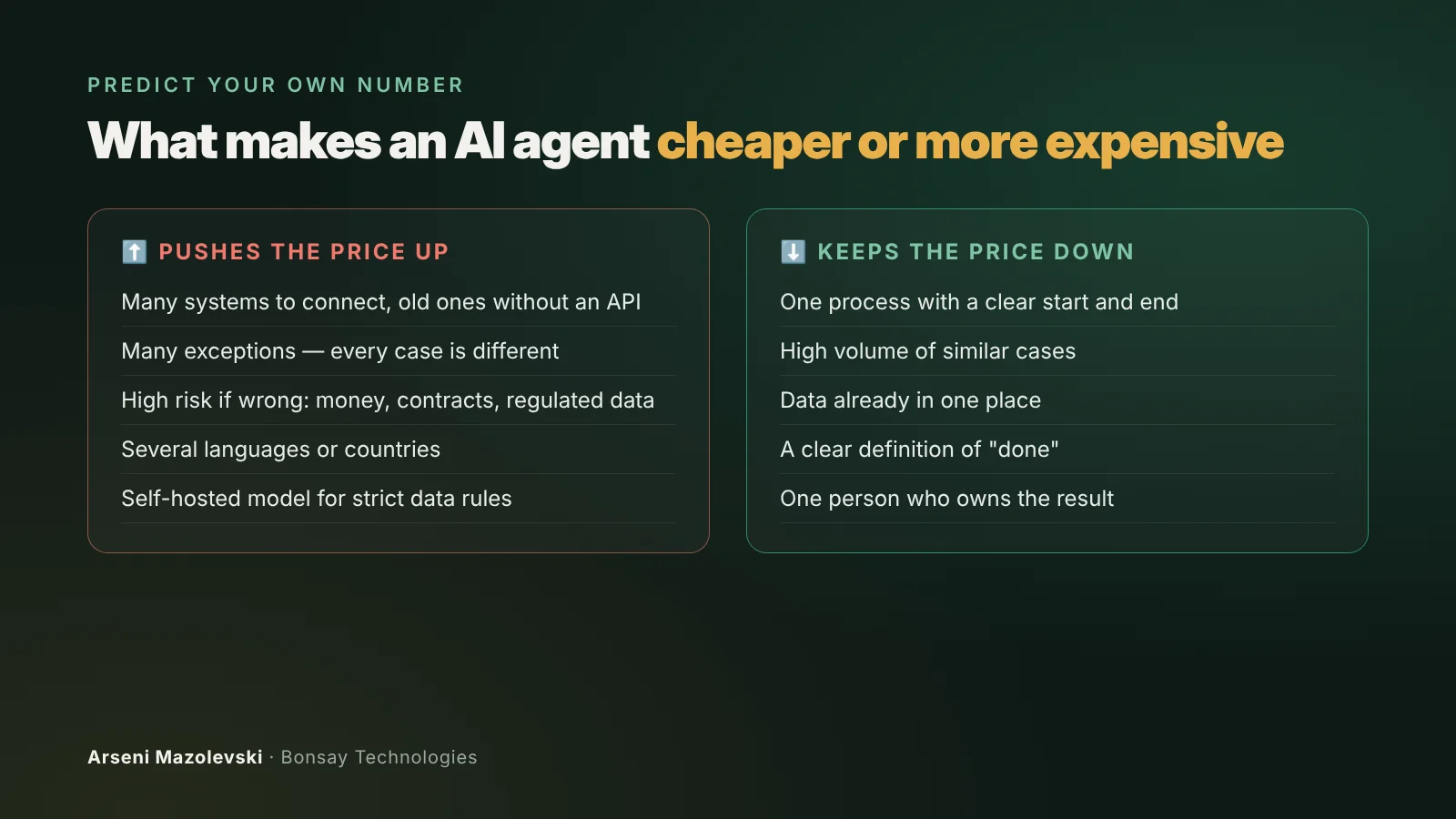
What pushes the price up:
- Many systems to connect (CRM, ERP, inbox, website, accounting), especially old ones without a proper API.
- Many exceptions, where every case is a little different.
- High risk if the agent is wrong (money, contracts, regulated data), which means more checks and approvals.
- Several languages or countries with different rules.
- Strict data requirements, such as hosting an open model on your own servers instead of using a cloud API.
What keeps the price down:
- One clearly defined process with a start and an end.
- A high volume of similar cases.
- Data that already exists in one place.
- A clear definition of "done" and a person who owns the result.
This is why it pays to start with one process. The most repetitive process is almost always the cheapest one to automate well, which is one more reason the first agent should usually answer customer enquiries rather than write strategy.
AI got 13 times cheaper. Why your project did not
The State of AI Report 2026 cites Epoch AI data showing that the price of a given level of AI performance has fallen about 47% per quarter, roughly 13 times a year. The report calls AI the fastest cost-reducing major technology since DNA sequencing.
That is real, and it matters. But it applies to the model, and the model is usually the cheapest part of a business agent. The same report adds a warning: with modern reasoning models, the price per token is a poor guide to the cost of an answer. A model that thinks longer uses more tokens, so what matters is the cost of a completed task.
The biggest part of the bill is not the model at all. It is the software around it — connections to your systems, data, checks, logs and the point where a person approves — which the industry calls the harness. That is where most of the engineering time goes, and engineering time does not get 13 times cheaper every year. Why the harness decides most of the result is covered in How to Choose an AI Development Partner.
Falling model prices make more projects worth doing. They do not make the work around the model disappear.
How the most successful companies budget for AI
McKinsey studied 20 companies that have proven themselves as AI leaders, in McKinsey Quarterly, 2026, issue 2. On average, their AI-driven transformations delivered a 20% EBITDA uplift, reached breakeven in one to two years and generated $3 of extra EBITDA for every $1 invested.
How they got there matters more than the totals. They concentrated on one to three business areas, made clear people accountable for the business numbers, and invested in stages, releasing the next budget only when the previous stage delivered.
These are large companies, so their numbers do not transfer to a smaller business; the method does. A stage-gated AI budget looks like this:
- Audit (1–2 weeks): pick one process, measure the baseline, get a fixed price and a payback estimate.
- Pilot (2–4 weeks): build the agent for that process and run it on real work, with a person approving.
- Decide: if the numbers moved, scale it or add the next process. If they did not, stop — you have spent a pilot budget, not a transformation budget.
How to measure whether the numbers moved is covered in AI ROI in 2026.
Fixed price or hourly rate?
Bonsay quotes a fixed price for an agent rather than an hourly rate, because the risk should sit with the people who can control it. After the audit the process, the systems and the data are known, and a price and a result can be committed to. Before the audit nobody can do that honestly, which is why there is no fixed price on day one.
Hourly work still has its place. When a company needs ongoing capacity — for example a forward-deployed AI engineer who sits with the team, extends agents and connects new tools — Bonsay provides engineers at €30–40 per hour. That is a different purchase: capacity, not a finished process.
For 2027 budgets the practical rule is to buy outcomes for the first agents, and to buy capacity once you know what you want to build next.
Where the engineering happens changes the bill
The model costs the same wherever the team sits. The engineering around it does not. Integrations, testing, monitoring and the months of small improvements after launch are steady, careful work, and they make up most of the lifetime cost of an agent.
That is why Bonsay combines senior AI engineers in Europe, close to the client's business and decisions, with engineering teams in Vietnam for the long tail of build and support work, all under an EU contract. The aim is not the cheapest hour; it is not spending the whole AI budget on the part of the project that never stops.
Your 2027 AI budget worksheet
Before approving any AI budget, fill in these seven lines for one process. It takes about 15 minutes.
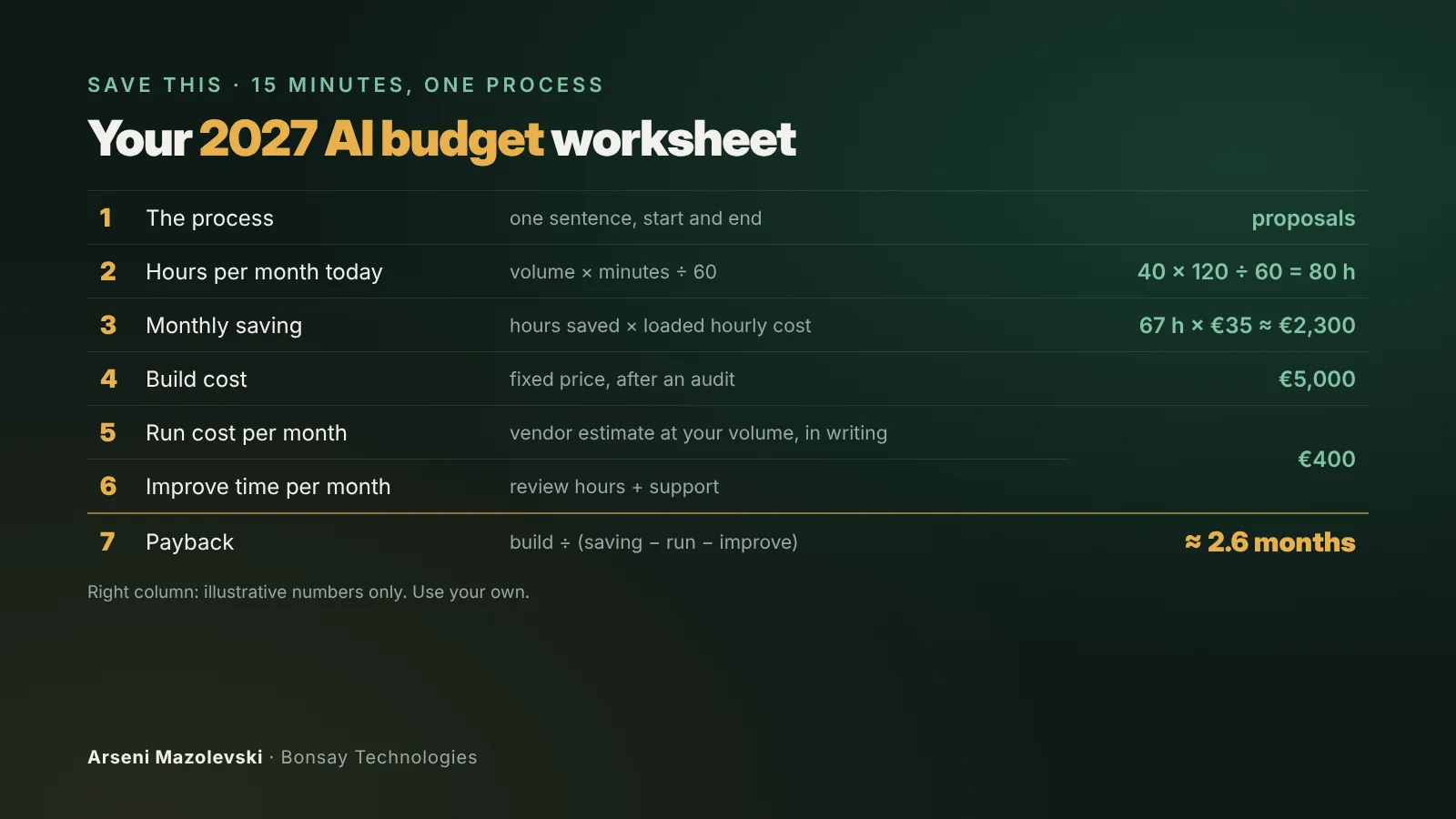
- The process: one sentence, with a start and an end.
- Hours per month today: volume × minutes per case ÷ 60.
- Monthly saving: hours saved × loaded hourly cost.
- Build cost: a fixed price from your vendor, after an audit.
- Run cost per month: ask the vendor for an estimate at your volume, in writing.
- Improve time per month: your team's review and correction hours, plus any support fee.
- Payback in months: build cost ÷ (monthly saving − run cost − improve cost).
An illustration with made-up numbers, to show the logic: a team writes 40 proposals a month at 2 hours each, which is 80 hours. With an agent drafting and a person reviewing in 20 minutes, it drops to about 13 hours. At €35 an hour, that saves around €2,300 a month. If the build is €5,000 and running plus review costs €400 a month, the agent pays for itself in under three months. Your numbers will differ, which is exactly why they are worth calculating.
The honest limits
- A price "from €5,000" is a starting point for one well-defined process. Several systems, many exceptions or strict data rules cost more, and that should come out in the audit, not after it.
- Run costs depend on volume and on the model. Reasoning models can cost more per task even when their token prices look lower.
- McKinsey's leaders are large companies. The method transfers to small businesses; the exact numbers do not.
- Some processes are not worth automating yet: too few cases, too many exceptions, or no one to own the result. A good partner says so before you pay for a build.
Get a fixed price for your first agent
Send Bonsay one process that eats your team's time. The audit ends with a fixed price for the build, an estimate of the monthly run cost at your volume and a payback calculation, before you commit to anything else — and if the numbers say it is not worth it, you hear that too. All published prices are on the pricing page; how a project runs from audit to production is on the AI & automation page, and finished projects are on the cases page.
Frequently asked questions
How much does an AI agent cost for a small business?
A first agent that automates one process has three costs: a one-time build, a monthly run cost and a monthly improve cost. At Bonsay the build starts from €5,000 at a fixed price, agreed after a 1–2 week audit. Several systems, many exceptions or strict data rules cost more.
What are the monthly costs of running an AI agent?
The run cost is what the AI provider charges for the model plus hosting and monitoring, and it depends mostly on volume. The improve cost is the time your team and your vendor spend reviewing results, fixing edge cases and keeping the agent up to date. Ask the vendor for a written run-cost estimate at your volume.
What makes an AI agent more expensive?
Many systems to connect, especially old ones without an API; many exceptions; high risk if the agent is wrong; several languages or countries; and strict data requirements such as hosting an open model on your own servers.
AI models keep getting cheaper. Why don't AI projects?
The price of a given level of AI performance has fallen about 13 times a year, according to Epoch AI data cited in the State of AI Report 2026. But the model is usually the cheapest part of a business agent. Most of the cost is engineering around the model — integrations, data, checks, logs and approvals — and that does not get 13 times cheaper every year.
Should an AI agent be bought at a fixed price or by the hour?
A first agent is best bought as an outcome at a fixed price, agreed after an audit when the process, systems and data are known. Hourly work suits ongoing capacity, such as an AI engineer who extends agents and connects new tools; Bonsay's engineers cost €30–40 per hour.
How do I calculate the payback of an AI agent?
Divide the build cost by the monthly saving minus the run and improve costs. In an illustrative example, an agent that saves about €2,300 a month, costs €5,000 to build and €400 a month to run and review pays for itself in under three months.
Sources
- Nathan Benaich and Air Street Capital, State of AI Report 2026, slides 109–110, citing Epoch AI.
- McKinsey & Company, McKinsey Quarterly, 2026, issue 2 — study of 20 AI-leading companies.
- Bonsay Technologies, published prices.