Key takeaways
- OpenAI and Anthropic run at about $105 billion of combined annualised revenue, up from about $30 billion at the start of 2026 (State of AI Report 2026).
- 69% of S&P 500 companies report live AI deployments; only 2% disclose AI metrics they track over time.
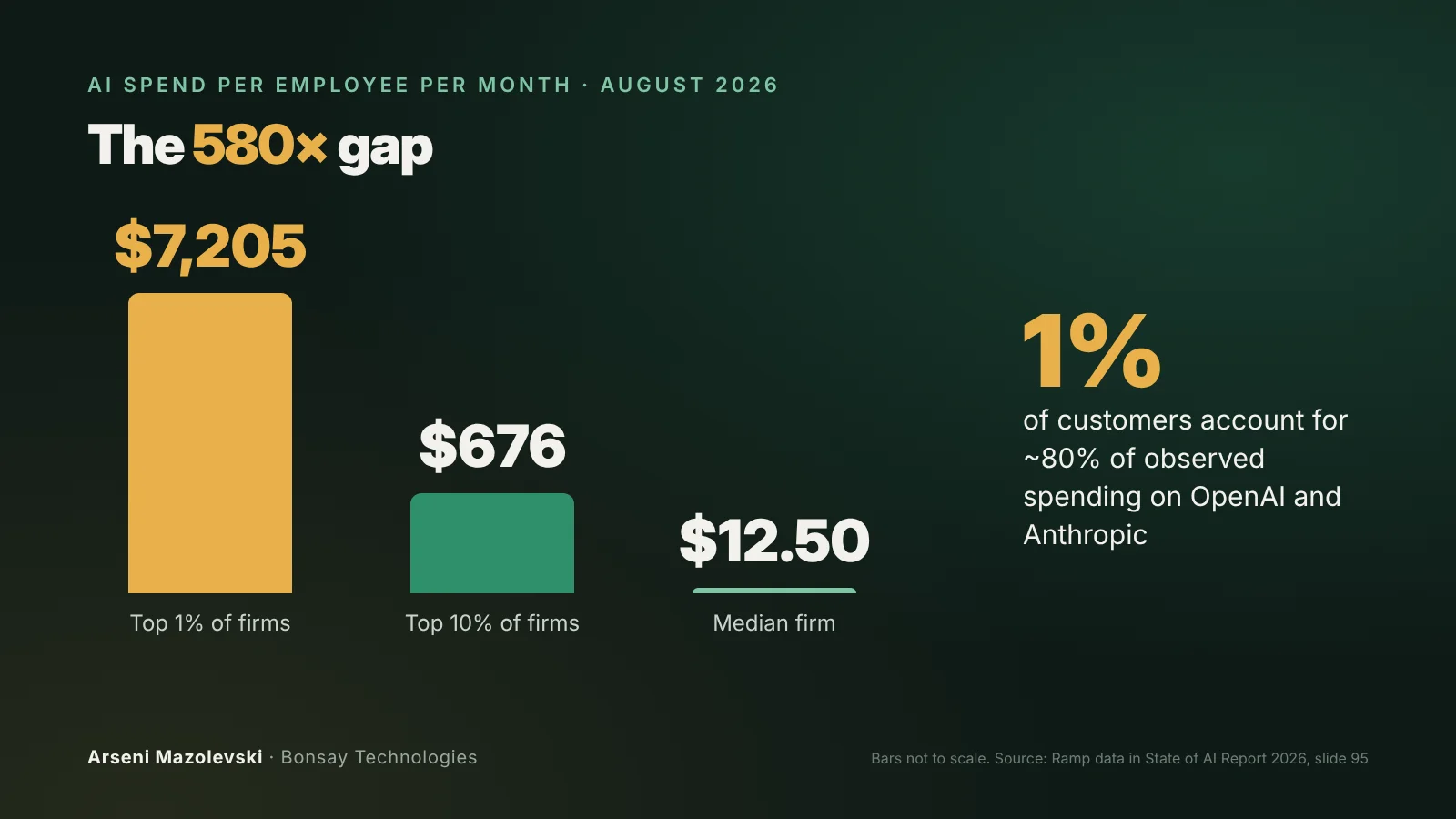
- The top 1% of firms spend $7,205 per employee per month on AI, the median firm $12.50 — a 580× gap (Ramp data).
- Heavy AI spenders that grew headcount spent $33.67 per worker per month: the difference is setup and measurement, not budget.
One number from the State of AI Report 2026 explains the AI return-on-investment problem better than most surveys. Inside OpenAI, 97.9% of active employees used Codex, the company's own coding agent, in a 28-day period. Among organisations that buy it, the figure was 17.3%; among individual users, 0.7%.
The same tool, in the same month, with a difference of more than a hundred times. The people who built it know how to use it; many of those who bought it do not. That gap — between buying AI and getting a return from it — runs through the whole report.
What the State of AI Report 2026 says about AI ROI
The report, published every year by Nathan Benaich and Air Street Capital, is one of the most cited reviews of the AI industry. Its 2026 edition has three findings that matter for companies deciding what to spend on AI in 2027.
The money is real. OpenAI and Anthropic now run at roughly $105 billion of combined annualised revenue, up from about $30 billion at the start of 2026.
Spending is extremely uneven. Ramp tracks what companies spend on AI through corporate cards and bill payments. In August 2026, the median company in Ramp's top 1% spent $7,205 per employee per month on AI; the top 10% spent $676; the median company spent $12.50. That is a 580× gap between the top 1% and the median. A separate Ramp analysis finds that 1% of customers account for about 80% of observed spending on OpenAI and Anthropic.
The proof is missing. An analysis of S&P 500 disclosures cited in the report found that 69% of companies report live AI deployments, but only 2% disclose AI metrics they track over time. Two out of three of the largest companies say AI is live; two out of a hundred can show a number moving.
Other surveys point the same way
Independent surveys describe the same pattern. Deloitte's State of AI in the Enterprise 2026 finds that 74% of companies hope AI will grow revenue, while 20% already see it. BCG's AI Radar 2026 reports that CEOs have committed more than 30% of their 2026 AI budgets to agentic AI and most expect agents to deliver measurable returns this year; only 6% say they would pull back if projects fall short. KPMG's Global AI Pulse adds the starkest figure: 95% of companies have an AI strategy, 8% report established ROI — a gap we covered in 95% Have an AI Strategy. 8% Can Show the Money.
Budgets are rising and confidence is rising. The number on the dashboard is not. The models are better than ever, so this is not mainly a technology failure — it is a setup failure.
Why most companies cannot measure AI ROI
The report puts the diagnosis in one line: "A Genius Bar for AI could help more people extract value through better tools and setup." Better tools and setup — not a better model.
In practice, three things are usually missing:
- No baseline. Nobody recorded how long the task took, or what it cost, before AI arrived, so there is nothing to compare against.
- No single process. The project is called "AI strategy" or "AI transformation". It touches everything, so it can be measured nowhere.
- No owner. Everyone uses AI a little; nobody is responsible for one number going down.
A return cannot be proven on something that was never defined.
Even the AI labs built deployment companies
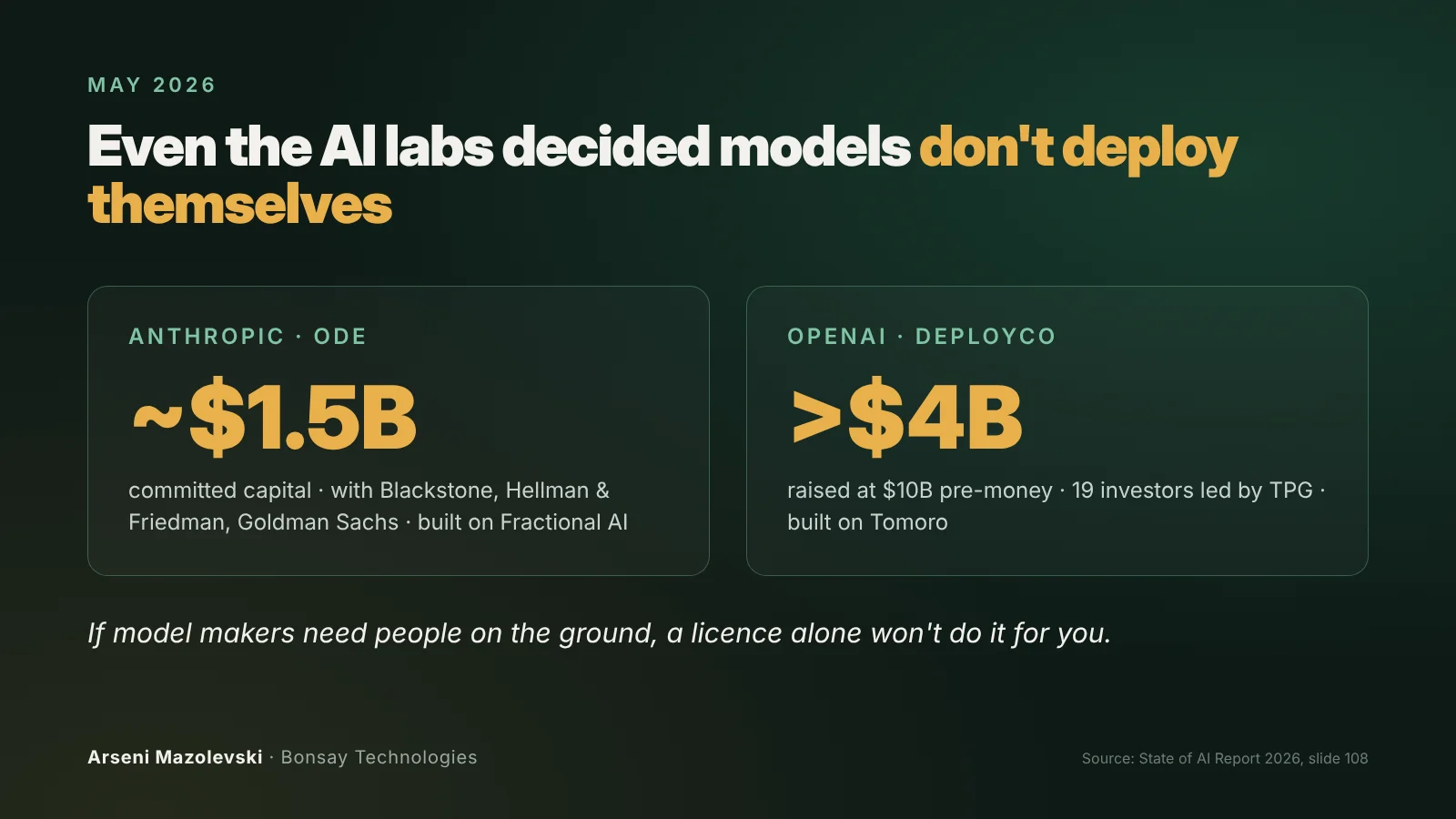
In May 2026, both leading AI labs set up deployment businesses backed by private equity. Anthropic's venture, Ode, was formed with Blackstone, Hellman & Friedman and Goldman Sachs, with about $1.5 billion of committed capital. OpenAI's Deployment Company raised more than $4 billion at a $10 billion pre-money valuation from 19 investors led by TPG. Both were built by acquiring smaller AI consultancies: Fractional AI for Anthropic and Tomoro for OpenAI.
The companies that build the strongest models concluded that a model alone does not get used — it needs people inside the customer's business to set it up. A licence on its own is unlikely to do more for an ordinary company.
The threshold is lower than it looks
The most useful detail in the report is easy to miss. Ramp linked AI spending to Revelio headcount data for 21,559 US companies. The heavy spenders — the top third — added 10.2% to headcount over two years, and 12% at entry level, while light adopters never separated from the control group. And "heavy spender" in that study meant $33.67 per worker per month, not $7,205.
BCG found a similar pattern from another angle: among 107 public technology companies grouped by AI token consumption, heavy users grew revenue about three times faster than light users over twelve months. Meanwhile the cost of a given level of AI performance keeps falling — by about 47% per quarter, or roughly 13 times a year, according to Epoch AI data cited in the report.
Money is not the barrier. What separates companies that grow with AI from those that do not is whether AI does real work every day in a way someone measures.
The limits of these numbers
- Ramp's data covers US card and bill-pay spending, not Europe or Asia.
- Spending is not value; some of the $7,205 per employee is certainly waste.
- "2% disclose metrics" describes public disclosure; some companies measure privately.
- The headcount and revenue studies show correlation, not causation. The report notes that most of the hiring gains sit in technology companies, and fast-growing firms may simply buy more AI.
The direction, however, is consistent: returns go to companies that set AI up for one real job and measure it.
How to measure AI ROI: a five-question test
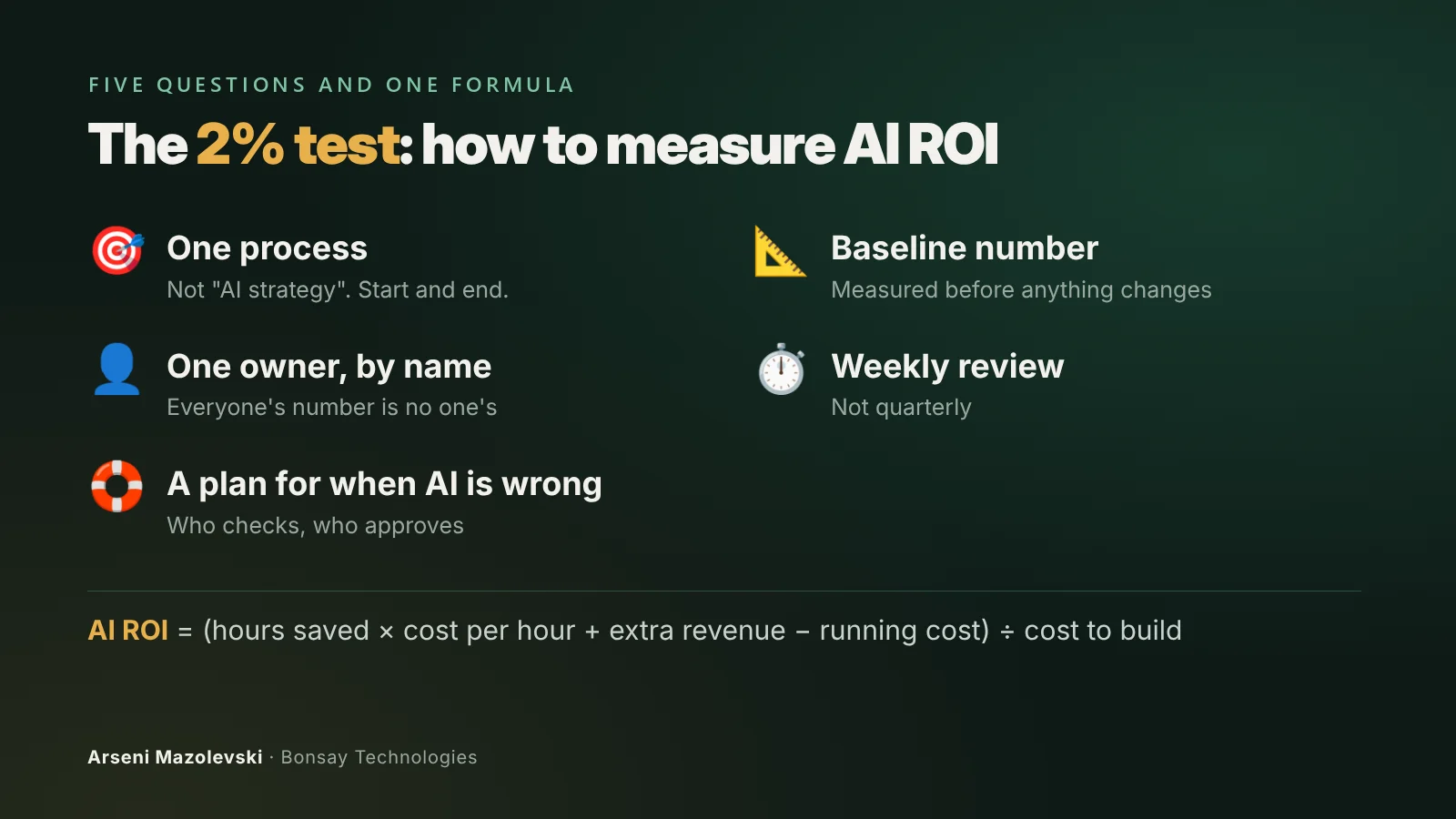
Before the next AI budget is approved, five questions should have written answers:
- Which one process is changing? Not "AI strategy" — one process with a start and an end: answering enquiries, preparing quotes, checking invoices.
- What is the number today? Response time, cost per transaction, hours per week or error rate, measured before anything changes.
- Who owns that number, by name? One person. A number that belongs to everyone belongs to no one.
- When is it reviewed? Weekly, not quarterly. AI systems drift, usage drops and edge cases appear.
- What happens when the AI is wrong? Who checks, who approves anything risky, and how a mistake becomes a fix.
A simple formula goes with the test: AI ROI = (hours saved × cost per hour + extra revenue − running cost) ÷ cost to build.
An illustration with made-up numbers: a team handles 400 customer enquiries a month at 12 minutes each — 80 hours. If an agent drafts every answer and a person approves it in three minutes, the work takes 20 hours, and the team gets back about 60 hours a month. At €30 an hour that is €1,800 a month before faster replies and won deals are counted — a number that can be checked weekly, with a payback period that can be defended. Why enquiries are often the best place to start is the subject of Your First AI Agent Should Answer Customer Enquiries.
What changes in 2027: the month after launch
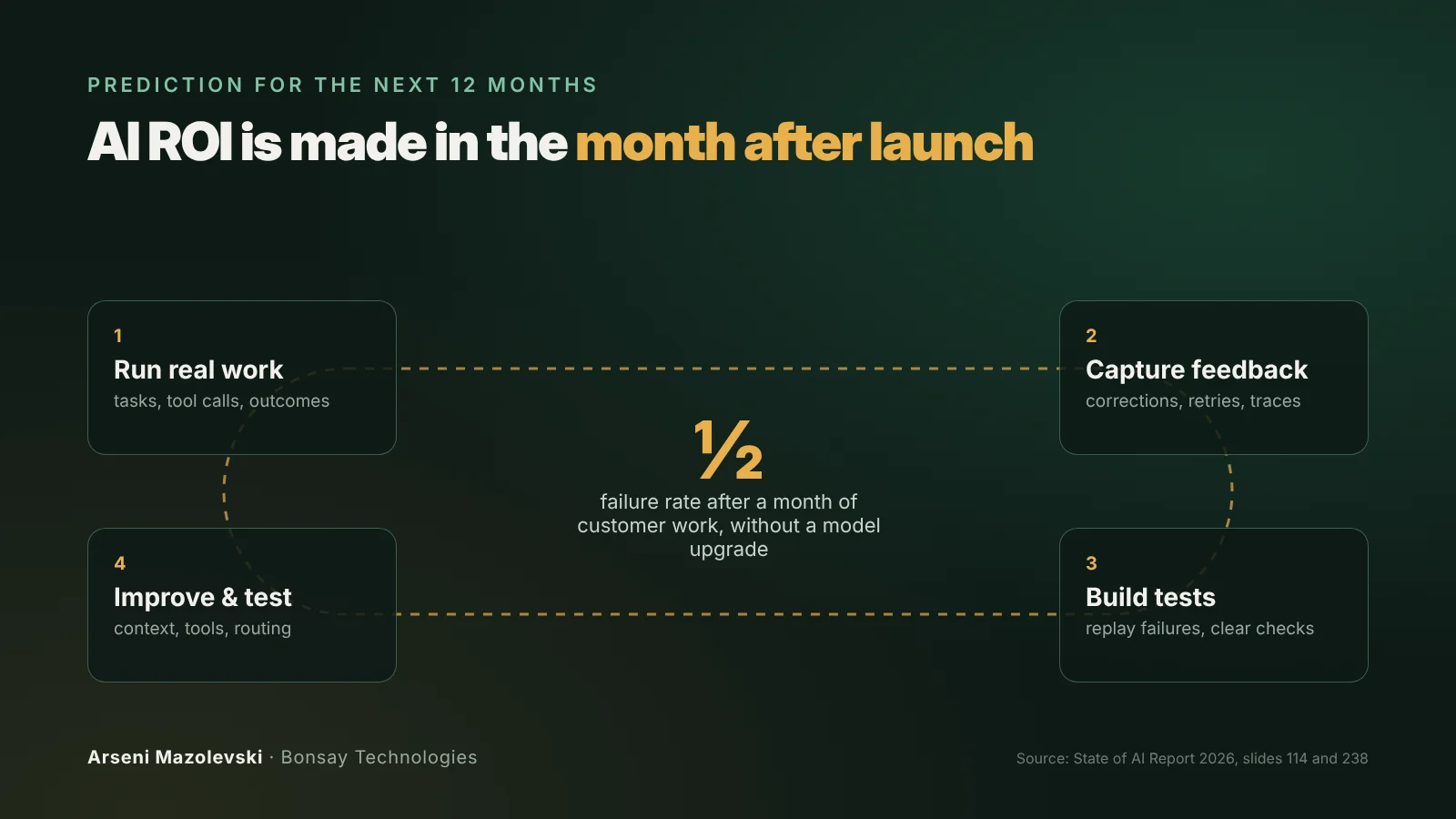
One of the report's predictions for the next twelve months is that an agent will halve its failure rate on new tasks after a month of customer work, without a model upgrade. The report calls the mechanism a production learning loop: run the agent on real tasks, capture every correction and retry, turn failures into repeatable tests, then improve context, tools or routing and test again before redeploying.
That loop is where AI ROI is made — not in the demo and not on launch day, but in the weeks after, when someone watches the number and fixes what breaks. The stakes are rising too: the share of individual Codex users giving the agent at least one task of roughly eight hours grew from 2.1% to 25.6% in the five months to May 2026. Bigger tasks mean bigger returns, and bigger mistakes when nobody is watching.
For companies starting out, the practical sequence is a process audit that sets the baseline, a pilot on one process with human approval for risky steps, and weekly measurement after launch — the approach described on the AI & automation page.
Sources
- Nathan Benaich and Air Street Capital, State of AI Report 2026 — including Ramp, Revelio, BCG and Epoch AI data cited in the report.
- Deloitte AI Institute, State of AI in the Enterprise 2026.
- BCG, AI Radar 2026: As AI Investments Surge, CEOs Take the Lead.
- KPMG, Global AI Pulse, Q1 2026.