Key takeaways
- 90% of companies have invested in AI, but fewer than 40% see measurable gains; about 60% of the potential value sits in sector-specific core workflows (McKinsey).
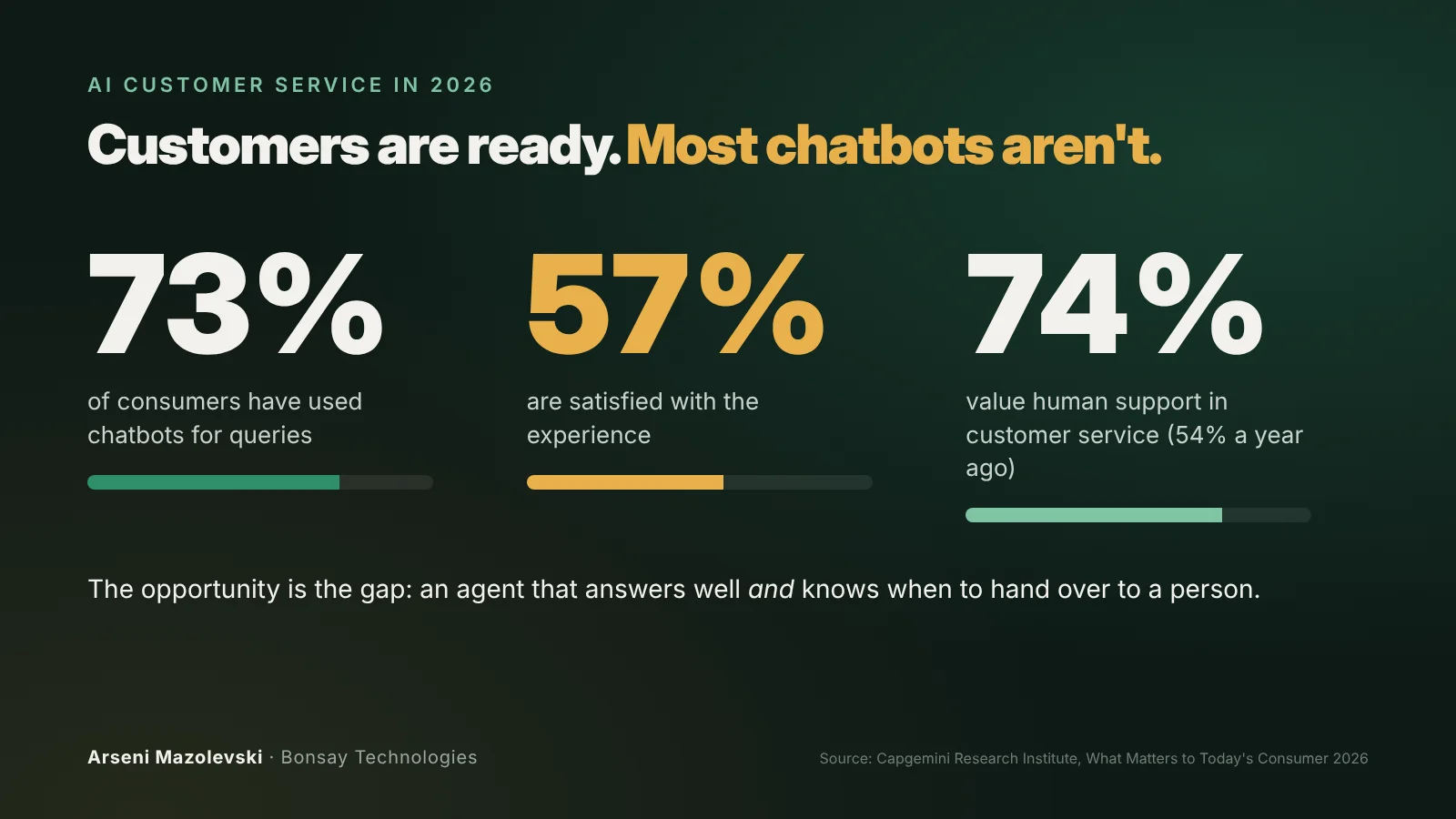
- 73% of consumers have used chatbots, only 57% are satisfied, and 74% value human support, up from 54% a year earlier (Capgemini 2026).
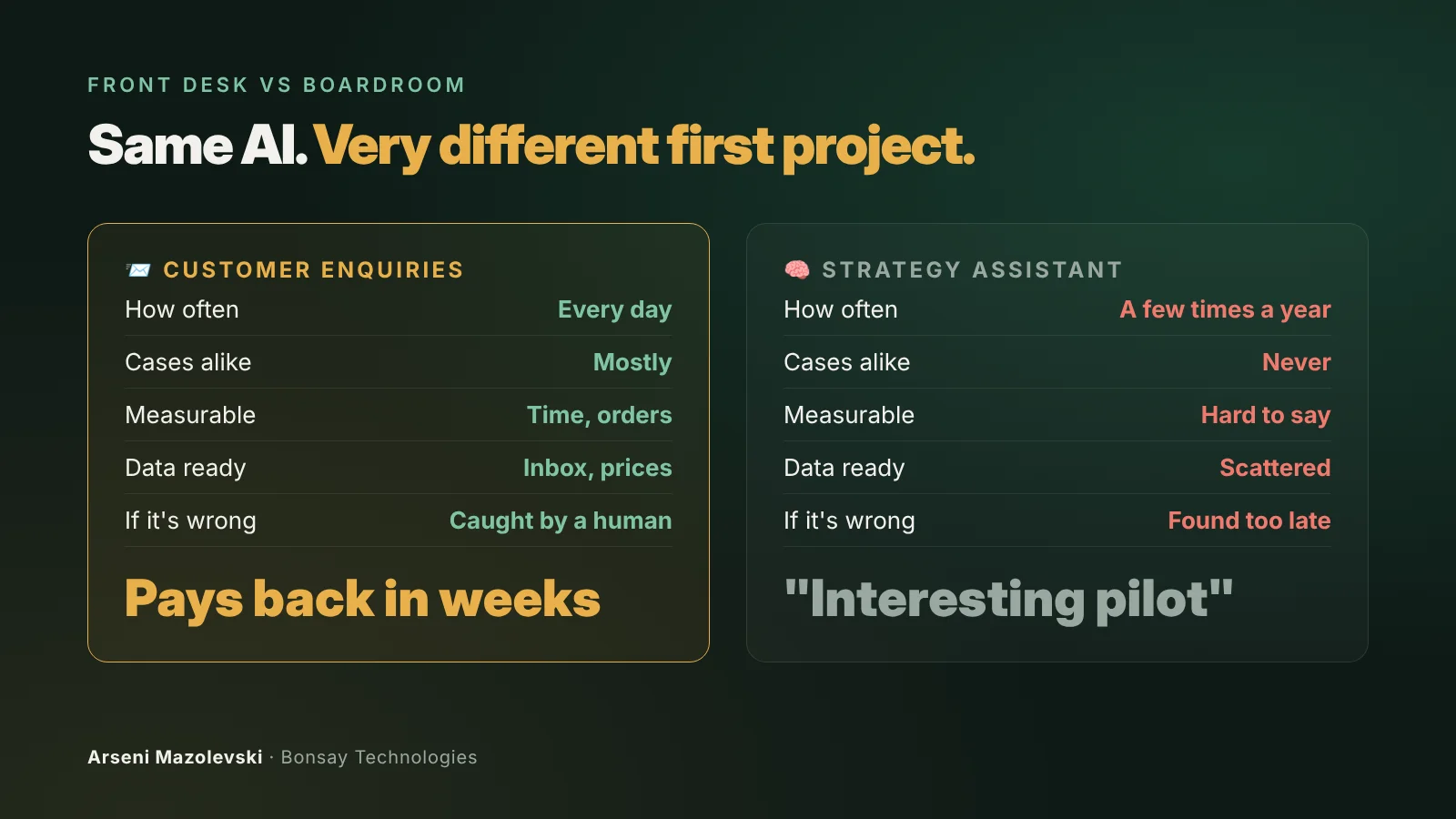
- Customer enquiries are frequent, repetitive and countable — the conditions under which an AI agent can be measured and improved.
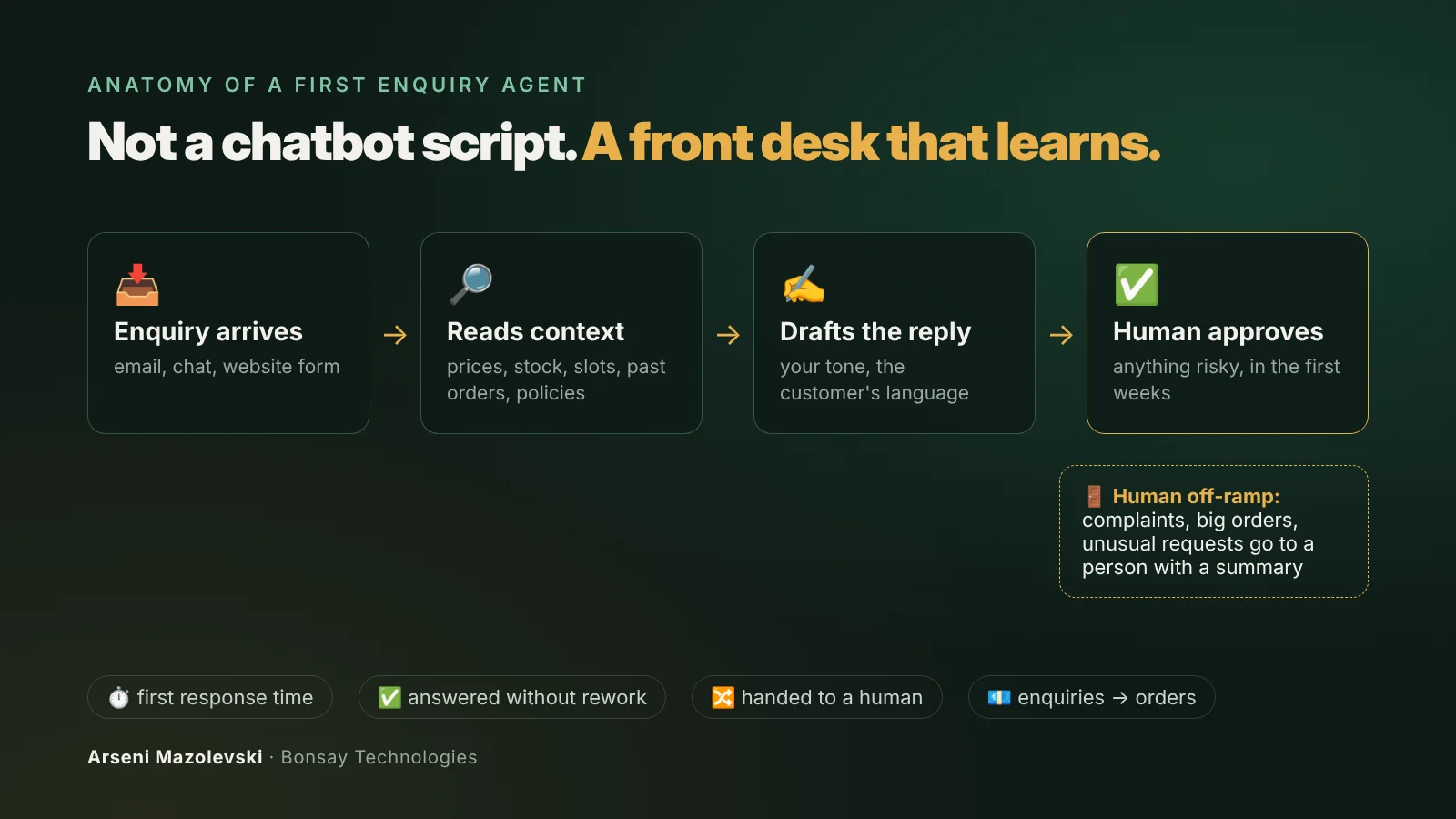
- A first agent needs four numbers from week one: first response time, answers without rework, hand-offs to a person and enquiries that become orders.
An AI agent that answers customer enquiries is usually the best first AI project for a small or mid-sized company. Enquiries arrive every day, most of them repeat, and every step can be counted — response time, answers that needed no rework, hand-offs to a person and enquiries that became orders — so the result can be measured from the first week.
Most companies planning their first AI agent choose between two ideas. One is an assistant for leadership: market analysis, board memos, support for strategic decisions. The other answers the questions customers send every day — prices, availability, delivery times, whether an order can be ready by Friday.
The first sounds more ambitious. The second usually pays back first, and is far more likely to still be running six months after launch. This article explains why, and how to choose a first use case that can be measured.
Why the first agent should be the boring one
McKinsey's research on AI adoption describes a gap between investment and results: about 90% of companies have invested in AI, while fewer than 40% report measurable gains. The McKinsey Global Institute adds that roughly 60% of the potential value sits in sector-specific core workflows — the everyday work particular to each business — rather than in general-purpose tools.
The State of AI Report 2026 shows the same gap from another angle: 69% of S&P 500 companies report live AI deployments, but only 2% disclose AI metrics they track over time. We look at that finding in detail in AI ROI in 2026.
Together these findings point to a practical rule: start where the work is frequent, repetitive and countable.
Strategy work fails all three tests. It happens a few times a year, every case is different, and nobody can say whether the AI-assisted version was better. Customer enquiries pass all three: they arrive every day, most of them repeat, and every step can be measured — response time, conversion and the share that needed a person.
What the data says about AI customer service in 2026
Customer service is where AI agents are moving fastest, and where the difference between good and poor execution is easiest to see.
- Customers already use it. Capgemini's What Matters to Today's Consumer 2026 finds that 73% of consumers have used chatbots for queries at least once, and query resolution and personalised post-purchase follow-ups rank among the features they value most.
- Most chatbots disappoint. Only 57% of users are satisfied. The reasons are limited problem-solving, weak understanding of context and difficulty reaching a person.
- People want a human option more than before. 74% value human support in customer service, up from 54% a year earlier. Capgemini recommends a "human off-ramp" that returns the conversation to an employee when the customer wants it.
- Agents are moving into operations. KPMG's Global AI Pulse finds agents deployed in technology (66% of companies), operations (55%) and marketing and sales (43%).
- The work is shifting. The State of AI Report 2026 cites three years of US employment data: customer service roles fell 9%, while data scientist roles grew 37%.
The distance between 73% usage and 57% satisfaction is the opportunity. Customers are ready for automated service; most implementations still fall short.
An enquiry agent is not a chatbot
Most disappointing experiences come from decision-tree chatbots built to keep customers away from staff. An enquiry agent works differently:
- It reads real context — prices, stock, delivery slots, past orders and policies — from the same systems the team uses.
- It drafts the answer an experienced employee would give, in the company's tone and the customer's language.
- It knows when to step aside. Complaints, large orders, unusual requests and upset customers go to a person with a summary, so nobody has to ask the customer to repeat themselves.
In the first weeks, a person approves risky answers before they are sent. That is how trust is built, with customers and inside the team. In the EU, the AI Act's transparency obligations apply from August 2026: people should know when they are talking to an AI system — which is also simply good design.
The economics, with illustrative numbers
Take a company that receives 600 enquiries a month, each needing about 10 minutes to answer properly — 100 hours of work. If an agent drafts 70% of the answers and a person approves each draft in two minutes, those 420 enquiries take 14 hours instead of 70. The team gets back about 56 hours a month; at €30 an hour, that is roughly €1,700 a month before counting any sales won by faster replies.
Real projects show the same direction. In one Bonsay project, an enquiry and booking agent that replies in under five seconds, collects the details, books the slot and sends a payment link helped the client grow direct bookings by about 20%. That is one client in one industry — a direction, not a benchmark — which is why every project should start by measuring its own baseline.
A strategy assistant has no comparable number to measure. That is the core difference between the two first projects.
Where enquiry agents go wrong
Starting with customer service can also fail, and the risks are worth stating plainly:
- A poor agent is worse than a slow person. The Capgemini satisfaction gap shows that customers notice when they are being kept away from staff.
- Some enquiries should never be automated. Complaints with legal weight, medical or legal questions and conversations with vulnerable customers go straight to a person.
- Vendor figures show a direction, not a guarantee. The examples below come from the vendors themselves.
- Results differ by business. Volume, seasonality and the quality of existing answers all change the outcome.
How to choose the first agent: a scorecard
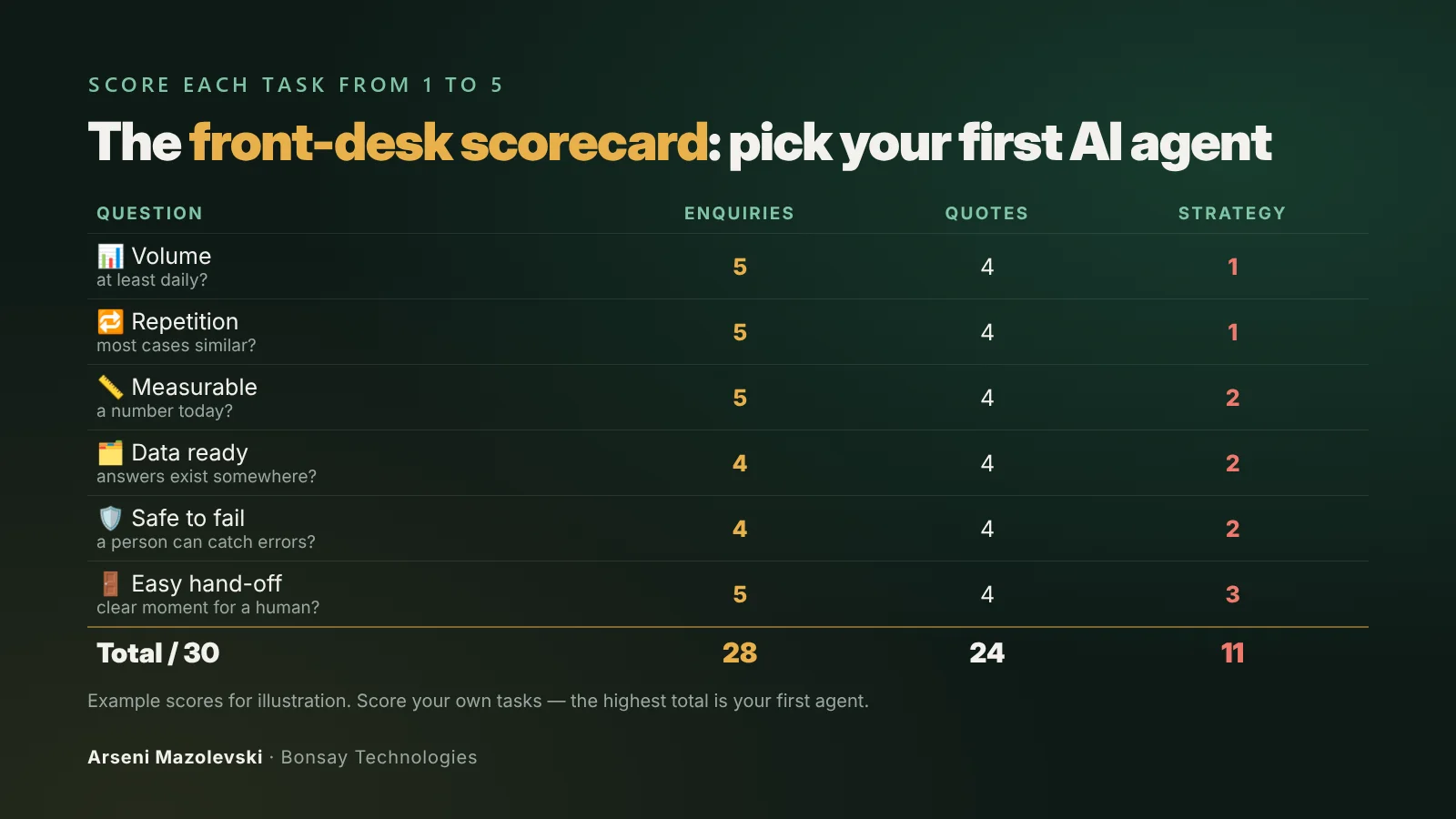
List three to five candidate tasks and score each from 1 to 5 on six questions. The highest total is the first agent.
Customer enquiries typically score 24–30 out of 30; strategy support usually scores under 15. Invoice matching, quote drafting and appointment booking land in between and make good second agents.
Once the agent is live, four numbers show whether it works:
- First response time.
- Share of enquiries answered without rework.
- Share handed to a person, and why.
- Enquiries that become orders or bookings.
If these numbers move, the company has an AI agent. If they do not, it has a demo.
What changes in 2027
The State of AI Report 2026 predicts that within twelve months an agent will halve its failure rate on new tasks after a month of customer work, without a model upgrade. For an enquiry agent, this means the month after launch matters more than the choice of model: every correction becomes a test case, and every approved answer becomes an example.
Changing agents is also getting cheaper. The same report notes that customer service agents used to be configured by vendors' engineers; now staff describe changes in plain English and approve fixes the system has already tested. PolyAI says its customers made 87% of their changes through its building agent in the week of 21 September 2026, up from 52% in mid-July; Decagon reports that time to go live fell by about 37%.
Companies that start at the front desk also build something they cannot buy: a year of real customer conversations, corrections and approved answers. That record becomes the starting material for every agent that follows — including, eventually, the strategic ones. The AI & automation page describes how such a project runs, from a process audit to an agent in production.
Start with one enquiry flow
Bonsay builds enquiry agents into the systems a company already uses: the inbox, the CRM, the booking or order system. Work starts with a two-week process and data audit that measures the baseline, and a working pilot runs in your environment two to four weeks later, with a person approving risky answers. One such project is the enquiry and booking agent on the cases page. How to tell a capable AI partner from a demo is covered in How to Choose an AI Development Partner, and how to measure the return in AI ROI in 2026.
Frequently asked questions
What should a company's first AI agent do?
For most small and mid-sized companies, answer customer enquiries. The work is frequent, repetitive and countable, so the agent can be measured and improved. Strategy support happens a few times a year, every case is different, and nobody can say whether the AI-assisted version was better.
Is an AI enquiry agent the same as a chatbot?
No. A decision-tree chatbot is often built to keep customers away from staff. An enquiry agent reads real context — prices, stock, delivery slots, past orders and policies — drafts the answer an experienced employee would give, and hands complaints, large orders, unusual requests and upset customers to a person with a summary.
How satisfied are customers with chatbots today?
Capgemini's What Matters to Today's Consumer 2026 finds that 73% of consumers have used chatbots for queries, but only 57% are satisfied. 74% value human support in customer service, up from 54% a year earlier.
How much time can an enquiry agent save?
It depends on volume. In an illustrative example, a company receiving 600 enquiries a month at about 10 minutes each spends 100 hours. If an agent drafts 70% of the answers and a person approves each in two minutes, the team gets back about 56 hours a month — roughly €1,700 at €30 an hour, before counting sales won by faster replies.
Which enquiries should not be automated?
Complaints with legal weight, medical or legal questions and conversations with vulnerable customers should go straight to a person.
How do you know the agent works?
Track four numbers from week one: first response time, the share of enquiries answered without rework, the share handed to a person and why, and enquiries that become orders or bookings.
Do customers need to know they are talking to AI?
In the EU, the AI Act's transparency obligations apply from August 2026: people should know when they are talking to an AI system.
Sources
- Capgemini Research Institute, What Matters to Today's Consumer 2026.
- Nathan Benaich and Air Street Capital, State of AI Report 2026.
- McKinsey Global Institute, Agents, robots, and us: Skill partnerships in the age of AI; McKinsey Quarterly, 2026, no. 2.
- KPMG, Global AI Pulse, Q1 2026.