Key takeaways
- Software developer pay ranges from €30–48k a year in Greece to €80–97k in Luxembourg, gross, from small companies to corporates (TalentUp 2026).
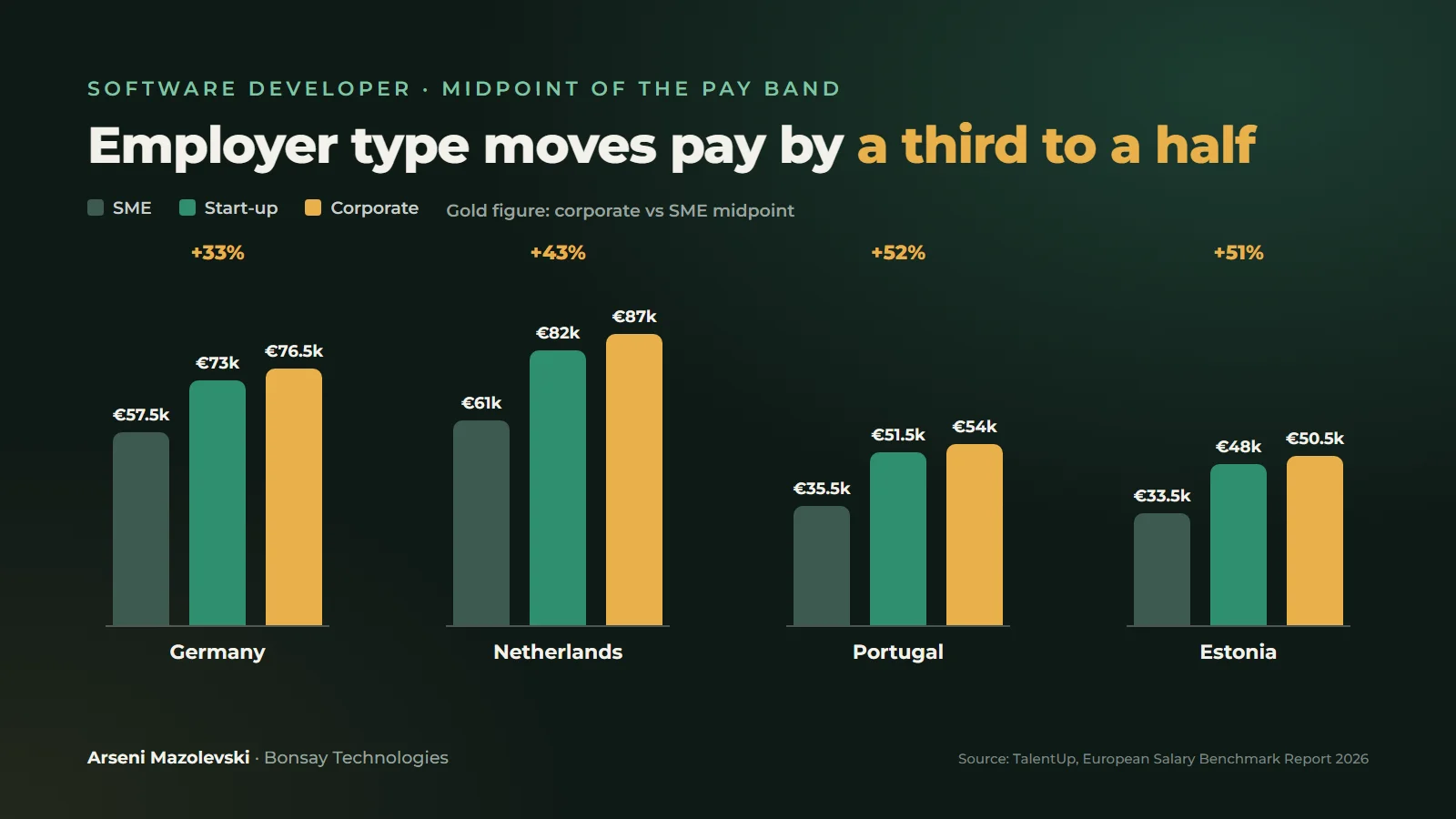
- Employer type moves pay by a third to a half: in all 15 countries, the corporate midpoint is 33–55% above the SME midpoint.
- Specialists earn most at the top of the range: in Germany, backend developers reach €110k and machine-learning engineers €114k at large companies.
- IT professionals in Europe stay with an employer for 19 months on average, and the EU Pay Transparency Directive makes salary ranges visible to candidates from June 2026.
What does a software developer cost in Europe in 2026? The honest answer depends less on the country than most hiring plans assume. TalentUp's European Salary Benchmark Report 2026 — built from more than 100 sources, 250 million professional profiles and 45 million salaries, updated monthly — shows that the type of employer moves pay almost as much as geography does.
This article summarises the figures for 15 euro-area countries, the premiums for specialist roles, and the new EU rules that will make salary ranges public.
How to read the figures
The bands below are annual gross salaries in euros, as published by TalentUp. Two details matter:
- Bands are split by employer type, not by seniority. Each country has three ranges: small and medium-sized enterprises (SMEs), start-ups and corporates. A senior engineer at an SME can earn less than a mid-level engineer at a corporate.
- Salary is not the cost of an engineer. Employer social contributions, recruitment, equipment, management and the time a role stays empty all come on top.
Countries outside the euro area are reported in local currencies and are left out of the comparison here.
Software developer salaries by country
The spread is wide: from €30–48k in Greece to €80–97k in Luxembourg. Luxembourg, the Netherlands and Ireland lead; Germany, Malta, France, Belgium, Finland and Italy form a broad middle group; Austria, Cyprus, Spain, Portugal, Estonia and Greece sit lower.
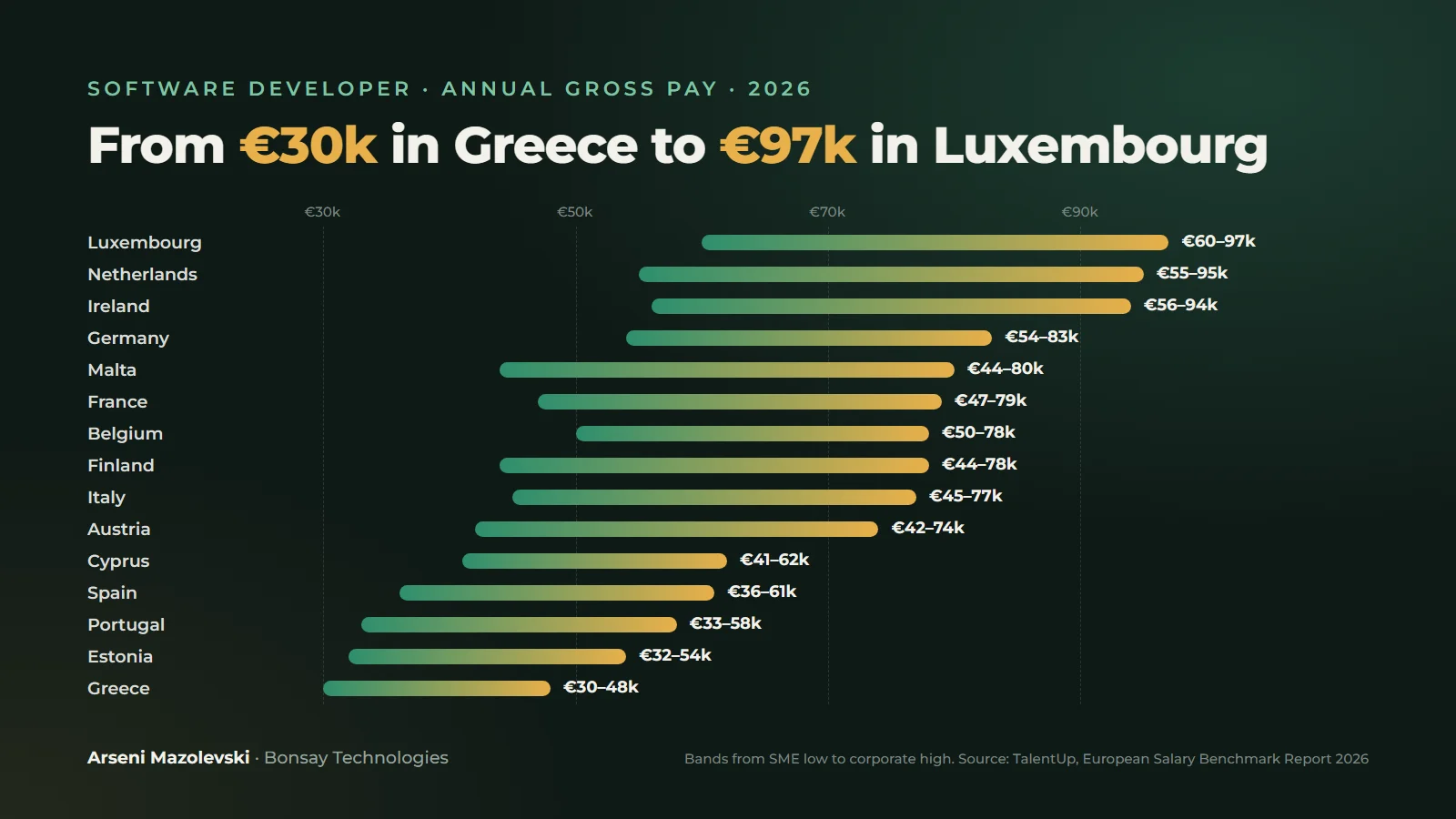
Software engineer salary in Europe per month
Divided by 12, the same bands give the monthly gross salary. Each range runs from the SME low to the corporate high, before employer contributions:
In Austria, Greece, Italy, Portugal and Spain, salaries are commonly paid in 13 or 14 instalments a year, so the monthly payslip there is lower than annual pay divided by 12.
For comparison with a hire: a full-time senior engineer from Bonsay at €30–40 per hour comes to about €4,800–6,400 a month for 160 hours, on one monthly invoice under an EU contract. Rates by role are on the senior engineers and pricing pages.
Employer type matters as much as country
Compare the midpoints of each band. In every one of the 15 countries, corporates pay 33–55% more than SMEs, and start-ups sit close to corporates:
- Germany: €57.5k at an SME, €73k at a start-up, €76.5k at a corporate (+33%).
- Netherlands: €61k, €82k and €87k (+43%).
- Portugal: €35.5k, €51.5k and €54k (+52%).
- Estonia: €33.5k, €48k and €50.5k (+51%).
The premium is largest in lower-cost markets. A corporate in Estonia pays more than an SME in Austria; a start-up in Portugal pays about as much as an SME in France. For a company hiring engineers, the relevant benchmark is therefore not "Germany" or "Portugal" but the employers it competes with for the same people — usually funded start-ups and large companies.
Specialist roles
Specialist roles stretch the range further, especially at the top. Bands below run from the SME low to the corporate high:
Two patterns stand out. In Germany and France, backend, data and machine-learning roles at large companies pay €100k or more — well above the generic software developer band. And in some markets, data engineering pays notably more than other roles: in Portugal, data engineers reach €83k while backend developers top out at €53k.
Salary is only part of the cost
Three factors usually matter more to a hiring plan than the gross salary:
- Time to hire. McKinsey's HR Monitor 2026 puts the median time to fill a role at 70 days across ten countries, with 11.6% of vacancies never filled — 13.3% in technology, media and telecoms. We covered the data in Hiring in 2026.
- Retention. TalentUp's data shows that IT professionals in Europe stay with an employer for 19 months on average. Hiring and onboarding costs are spread over a short tenure.
- Employer costs. Social contributions, equipment, office or remote-work costs and management time come on top of gross salary and differ by country.
A role budgeted at its gross salary is therefore always underestimated — and a role that stays empty for three months has a cost of its own, in delayed product work.
What the EU Pay Transparency Directive changes
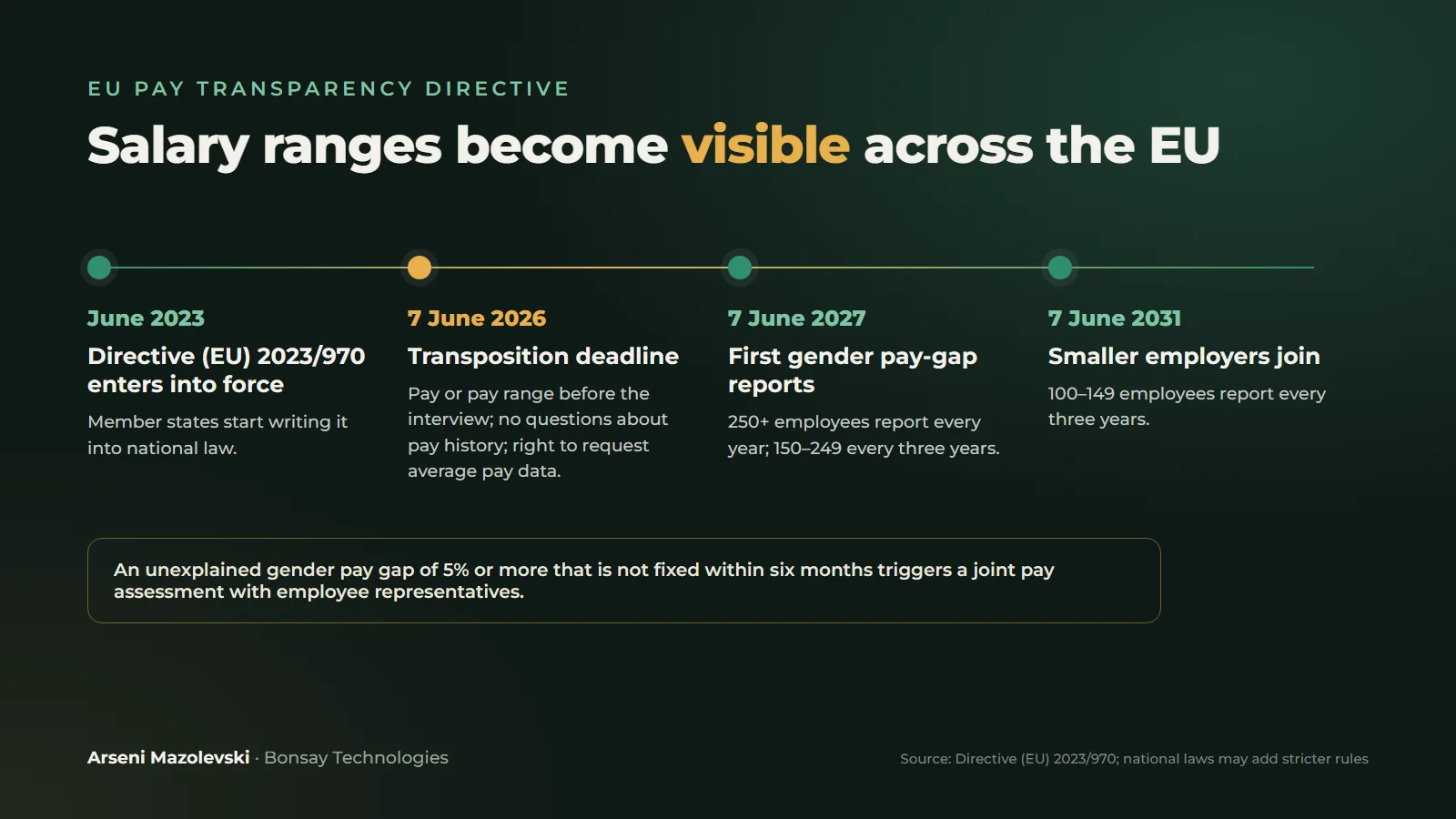
Directive (EU) 2023/970 had to be written into national law by 7 June 2026. Its main effects on hiring:
- Pay before the interview. Candidates must receive information about the starting pay or pay range of a role, typically in the job advert or before the interview.
- No pay-history questions. Employers may not ask candidates about their current or previous pay.
- Right to information. Employees can request average pay levels, broken down by gender, for workers doing the same work or work of equal value.
- Reporting. Employers with 250 or more employees report gender pay-gap figures every year from 7 June 2027; those with 150–249 every three years from 2027; those with 100–149 every three years from 2031.
- Remediation. An unexplained gender pay gap of 5% or more that is not corrected within six months triggers a joint pay assessment with employee representatives.
National rules vary in timing and detail, and some member states add stricter requirements. The direction is the same everywhere: salary bands will become visible to candidates, competitors and employees — which makes accurate benchmarks more important, not less.
What this means for planning an engineering team
- Benchmark against your real competitors. If start-ups and corporates are hiring the same engineers, their bands — not the national average — set the price.
- Budget for the total cost. Gross salary, employer contributions, time to hire and an average tenure of 19 months belong in the same calculation.
- Expect visible ranges. From 2026, candidates will compare published bands across employers before the first call.
- Consider several hiring markets. Distributed teams, contractors and managed engineering teams spread both cost and hiring risk. Bonsay publishes its own rates for senior engineers and pods on the pricing page, including a delivery centre in Ho Chi Minh City.
Frequently asked questions
What is a software engineer's salary in Europe per month?
Across the 15 euro-area countries in TalentUp's benchmark, gross monthly pay runs from about €2,500 in Greece to about €8,100 in Luxembourg (annual pay divided by 12). Germany sits at about €4,500–6,900 a month and the Netherlands at about €4,600–7,900.
Which European country pays software developers the most?
Luxembourg, at €60–97k a year, followed by the Netherlands (€55–95k) and Ireland (€56–94k). Corporates and funded start-ups pay at the top of each band.
Where in the euro area are software developers paid least?
Greece (€30–48k a year), Estonia (€32–54k) and Portugal (€33–58k). The gap between SMEs and corporates is widest in these lower-cost markets.
Sources
- TalentUp, European Salary Benchmark Report 2026 (100+ sources, 250 million profiles, 45 million salaries; bands by employer type).
- Directive (EU) 2023/970 of the European Parliament and of the Council on pay transparency.
- McKinsey & Company, HR Monitor 2026, June 2026.